Contents

Frozen Food Packaging Costs: Prevent Failures First, Then Consider Cutting the Structure
For frozen meat, fish, seafood and fish balls, the pouch works in harsh conditions: the low temperature of cold storage, knocks during stacking and transport, and long storage times. When packaging fails, the company loses not just the pouch but the product inside it.
So optimising frozen packaging costs should follow an order: first stop the failures that cause spoilage, then check whether any film layer or feature goes beyond what is needed.
The real cost of a frozen food pouch
The unit price of frozen food pouches, like other custom-printed packaging, depends on structure, size, number of print colours, converting details and volume. The larger the volume, the more competitive the unit price.
But the unit price is only part of it. When a pouch fails, the costs come from elsewhere:
- The product oxidises, loses moisture or develops surface ice, affecting colour and quality.
- Pouches tear or puncture in transit, and goods have to be repacked or discarded.
- Seals open and air gets into the vacuum pouch.
- Printed labels miss information or contain errors, and the whole packaging batch has to be reprinted.
A pouch with a lower unit price that causes these failures ends up with a higher total cost.
Three common failure points and how to prevent them
Punctures and tears
Frozen packaging must be tough enough not to puncture during stacking in storage and transport. A punctured pouch loses its vacuum, and the product inside loses its protection.
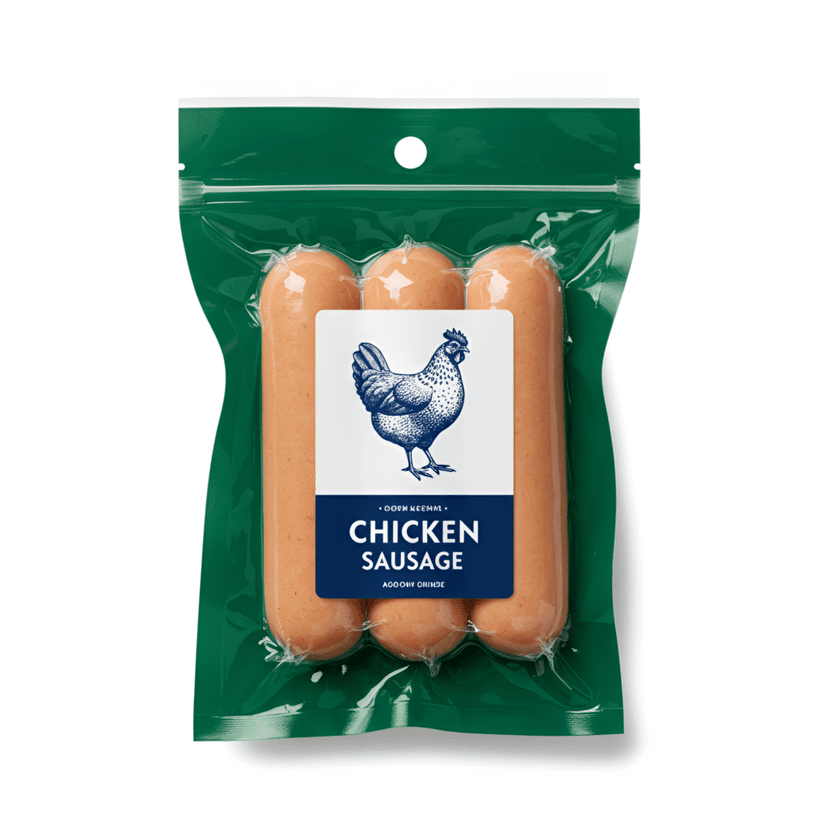
This is why PA/PE laminated vacuum pouches are widely used for frozen goods. The PA (nylon) layer is tough, abrasion-resistant and puncture-resistant. The PE layer resists moisture and helps make a strong seal. PA/PE pouches usually have two to three laminated film layers.
When making samples, test the pouch with the real product, packed and stacked as in actual production conditions, not just by checking empty pouches.
Open seals
In a vacuum pouch, the seal is what keeps the pouch airtight. If the seal opens, air gets in and the product loses the protection of the vacuum.
Two sides need to be controlled:
- The packaging manufacturer's side: the inner sealing layer must seal well, and seal strength must be tested. At KOVAA, testing equipment measures tensile strength at break and seal strength, and the quality control process includes a heat-resistance test of the seal.
- The food plant's side: sealing settings on the machine must match the film in use. When changing structure or supplier, run a trial on your own sealing machine before mass production.
Brittle cracking at low temperatures
Frozen packaging must withstand the temperature of cold storage without becoming brittle and cracking. A film that suits dry goods at room temperature may not stay flexible in cold storage. This is not the place to save money by reusing another product's structure.
PA withstands cold well, so the PA/PE structure is a common choice for frozen meat, fish, seafood and fish balls.
When multi-layer film is needed, and when it is not
Once the failures above are under control, you can check whether the structure goes beyond what is needed. KOVAA's product pages suggest structures by product and market:
| Case | Common structure |
|---|---|
| Frozen meat, fish, seafood fillets, fish balls | PA/PE vacuum bag |
| Pre-processed, frozen seafood | PA/PE or PET/MPET/PE vacuum pouches |
| Export seafood, premium frozen goods | Multi-layer film such as PET/PA/PE, PET/AL/PA/PE, PET/MPET/PE for oxidation resistance |
| Goods for the domestic market, short-term storage and display | PE Bags |
An AL or MPET layer gives better oxidation resistance, but it is also one more film layer. If the product is sold domestically, storage time is short and no light barrier is needed, ask whether a PA/PE structure is already enough. On the other hand, for export goods on long journeys, cutting the anti-oxidation layer is a risk.
The pouch style should also be chosen by how the product is sold. Frozen pouches can be made as side-seal, back-seal, four-side seal, zipper or roll formats. Zipper pouches and stand-up pouches are convenient for goods split into small portions and opened and closed many times in restaurants and supermarkets. For goods packed once and then frozen, a simple pouch style is usually enough. For automatic packaging lines, film rolls help cut labour costs.
Information printed on the packaging: avoiding reprints
Frozen packaging usually needs to carry the logo, ingredients, origin, production date, expiry date, storage instructions and barcode. KOVAA prints this information by gravure printing.
To avoid reprinting a whole batch:
- Review the mandatory label information carefully before approving the file.
- Keep information that changes by batch, such as production date and expiry date, out of the pre-printed area if the plant has a date coder.
- Approve the test sample before confirming the order.
What information to send for a quote
For KOVAA to propose a suitable structure and quote, send:
- Product type and processing: whole, fillet, fish balls, ready-to-cook goods.
- Weight per pack and product size.
- Market: domestic or export.
- Packing method: manual vacuum sealing, a sealing machine, or a line using film rolls.
- Expected volume per run and order frequency.
- Your current packaging and quote, if any, so KOVAA can quote back for you to compare.
See examples in the frozen food packaging category, along with the frozen meat and fish packaging and fish ball packaging pages. If you are reviewing packaging costs across a whole product line, the article what drives the unit price of plastic food packaging may help.
Send your product, packing spec and expected volume via Zalo or the Contact page for KOVAA to advise on the structure and quote.