Contents

How to Work with a Packaging Manufacturer to Lower Total Cost
When comparing packaging suppliers, many companies simply put two unit prices side by side. But for a manufacturer with steady volume, the real packaging cost is the sum of many items over the whole year, not just the number on one quote.
This article focuses on the costs a company can actively reduce when working with a packaging manufacturer: how specs are set, how designs are made, how volume is communicated and how samples are approved.
What total packaging cost includes
Besides the unit price per pouch or per metre of film, total packaging cost usually includes:
- Set-up cost for each print design. With gravure printing, each design needs its own set of printing cylinders. The more versions a design has, the larger the set-up cost.
- Design change costs. Every time information is corrected, the layout is changed or a version is added, the file is redone, approved again and the cylinders may have to be remade.
- Defects and reprints. Wrong label information, wrong colours or a size that does not match the packaging machine all lead to reprints.
- Packaging inventory. Packaging printed for an old design becomes waste when the label changes.
- Packing labour. The packaging format decides whether goods are packed by hand or on a machine.
A low unit price with high costs elsewhere still means a high total cost. The four steps below target each of these items.
1. Standardise specs across products
Many companies have dozens of SKUs, each with its own size, film structure and pouch style. Each separate spec is a separate order with a smaller volume.
For custom-printed packaging, the larger the volume, the more competitive the unit price. So it is worth reviewing your product range and asking:
- Which SKUs have similar pack weights and could share one pouch size?
- Which SKUs have the same storage risks and could share one film structure?
- Which SKUs go through the same sales channel and could share one pouch style?
For example, dry goods usually use OPP/CPP or PET/PE, while coffee, tea and nuts use film with an MPET or foil layer. Several SKUs in the same group can share one structure to pool volume.
When talking to the manufacturer, ask how they count volume when several print designs share one spec. The answer directly affects how you combine orders.
2. Build one design system shared across SKUs
The number of print colours is one factor in the unit price. In addition, each design needs its own printing cylinders. So the way designs are made affects the cost of the whole product line.
An effective approach is to split the design into two parts:
- Shared part: background, logo, layout, information panel. This part stays the same on every SKU.
- Specific part: product name, flavour, identity colour, barcode. This part changes by SKU.
When you receive a quote, ask three things clearly: how the cylinder cost is calculated, which cylinders can be reused between designs, and whether the cylinders are kept for the next print run. These are questions about each manufacturer's own policy, so the answers should be given in writing with the quote.
Information that changes often, such as batch number, production date and expiry date, should be kept out of the pre-printed area, with a blank space left for a date coder. That way one packaging design can serve many batches without reprinting.
3. Share volume forecasts and the order schedule in advance
A manufacturer can only quote for the volume you tell them. If you only ever ask for the quantity of a single order, the quote will be based on that quantity.
When asking for a quote, send:
- Expected volume per run.
- How often you order during the year.
- The months with higher demand, if the product is seasonal.
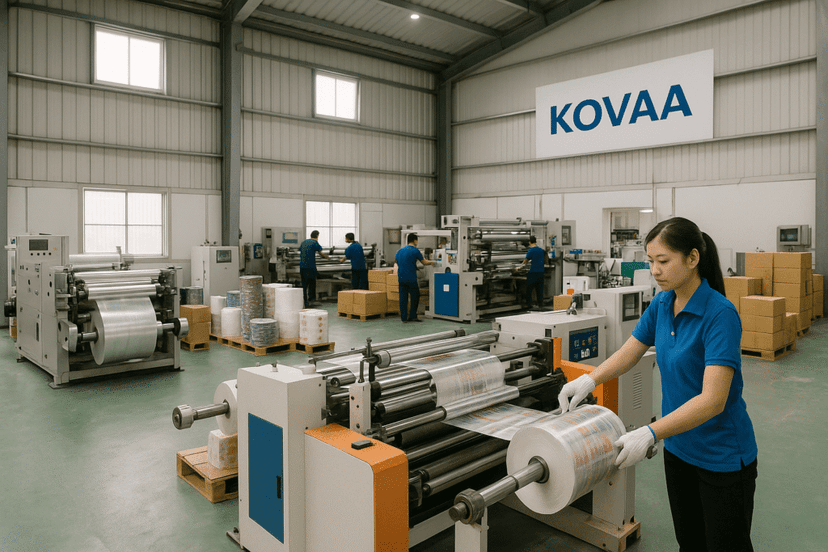
An order plan also helps avoid rush orders and leftover stock of old-design packaging when the label changes. Production time depends on volume, packaging structure and the complexity of the print design, and should be confirmed with the quote for each order.
4. Reduce defects and reprints
A misprinted batch of packaging is a total loss: material, printing work, time, and sometimes your own delivery schedule as well. Most of these errors can be stopped before production.
On the brand owner's side:
- Check the mandatory label information carefully before approving the file.
- Send the correct packaging machine specs if you use film rolls: film width, core diameter, thickness and film structure.
- Approve the print proof and receive test samples before confirming the order. The print ordering process usually goes through choosing size, material and design, the quote, receiving test samples and confirming the order, and only then production and delivery.
On the manufacturer's side: ask what they check on each batch. At KOVAA, quality control includes visual and structural checks (print colour, ink adhesion, film delamination), mechanical strength tests (drop tests, tensile strength at break, heat resistance of the seal) and gas barrier tests.
When changing packaging suppliers
Changing suppliers is when hidden costs arise most easily. For the new print to match the old one and run on your existing machines, prepare:
- A sample of the packaging you currently use.
- The original design files.
- Film specs: structure, thickness, size.
- Colour requirements, if there are brand colours that must be matched exactly.
- Packaging machine specs, if you use film rolls.
If you have a quote from your current supplier, you can send it along so KOVAA can quote back on the same spec for you to compare.
What KOVAA does in this chain
KOVAA is a manufacturer of custom-printed flexible plastic and laminated-film packaging. The line covers PE/PP film blowing from virgin resin, gravure printing, film lamination, slitting and automatic bag making.
Products include finished pouches such as back-seal pouches, three-side seal pouches, zipper pouches, and film rolls for automatic packaging machines. Depending on the order, film rolls are quoted per metre or per kg. KOVAA does not make paper boxes, tin boxes, PP woven sacks or garbage bags, so those types of packaging need another supplier.
See also: plastic food packaging costs and how to choose a structure that is just enough, or the custom-printed back-seal pouch service.
Send your SKU list, current specs and expected volume via Zalo or the Contact page. KOVAA will look at which specs can be shared and quote based on your volume.